
07 Oct
Key Takeaways
01
End-to-end ownership
and stronger connection with global teams.
02
Clearer career growth
through leadership and global opportunities
03
Better work-life balance
and employee experience.
04
Competitive pay and greater stability
for long-term careers
05
Global accounting exposure
across finance, technology, and transformation
06
Expert GCC advisory
across strategy, compliance, infrastructure, HR, and operations.
Introduction
India-based Global Capability Centers (GCCs) have evolved from cost-saving back offices into strategic hubs delivering advanced technology, analytics, and business services. For accounting professionals, GCCs provide direct roles with global exposure, training in international accounting standards, and long-term career opportunities within multinational organizations.
As GCCs continue to expand across India, they are increasingly becoming the preferred workplace for accounting professionals seeking meaningful work, career growth, and global exposure.
End-to-End Ownership and Stronger Cultural Alignment
Working in a Global Capability Center of a leading accounting firm is fundamentally different from a traditional outsourcing setup.
Professionals:
- Manage entire accounting and audit processes from end to end.
- Gain visibility into business strategy and outcomes.
- Collaborate directly with global clients and teams.
- Contribute to analytics, automation, and digital transformation initiatives.
- Operate as an integral part of the firm’s culture and values rather than as an external service provider.
- Access leadership opportunities and global exposure within a unified organization.
This sense of ownership and belonging creates a stronger connection between employees and the organization.
Better Work-Life Balance Than Traditional Firms
Accounting GCCs provide a more balanced working environment compared to traditional consulting firms.
According to the whitepaper, professionals benefit from:
- Structured and predictable working hours.
- Better work-life balance.
- Competitive compensation and comprehensive benefits.
- Exposure to international accounting standards such as IFRS and US GAAP.
- A supportive work environment focused on long-term career development.
Unlike traditional consulting environments characterized by excessive pressure, unrealistic deadlines, and high burnout, GCCs provide structured global policies and healthier workplace expectations.
Post-pandemic, GCCs have also widely adopted remote and hybrid working models, improving work-life balance while supporting employee well-being.

Clear Career Growth and Global Exposure
Accounting GCCs provide structured career development that extends beyond routine accounting work.
Professionals have opportunities to:
- Progress through clearly defined career paths.
- Advance into leadership positions.
- Participate in global rotations and cross-border projects.
- Build expertise across tax, digital transformation, and other finance functions.
- Receive mentorship from global leaders.
- Contribute to strategic initiatives in automation, analytics, and digital audit.
The whitepaper also notes that accounting GCCs promote employees to senior roles up to 25% faster than outsourcing environments.
Competitive Compensation and Long-Term Security
For professionals working in Accounting GCCs, compensation extends beyond salary.
The whitepaper highlights:
- Global salary benchmarking.
- Merit-based progression.
- Performance-linked bonuses.
- Comprehensive healthcare and retirement benefits.
- Investment in continuous learning and professional certifications.
- Greater job security during market slowdowns.
Accounting GCCs also demonstrate 15–20% lower attrition than outsourcing vendors because employees are more closely integrated into the global organization.
A Workplace Built for Long-Term Careers
Accounting GCCs treat professionals as strategic contributors rather than cost resources.
Employees gain:
- Global exposure.
- Continuous learning opportunities.
- Professional development.
- Leadership opportunities.
- Long-term career progression.
- A stronger sense of belonging within the global organization.
These advantages create lasting value for professionals while supporting sustainable career growth.
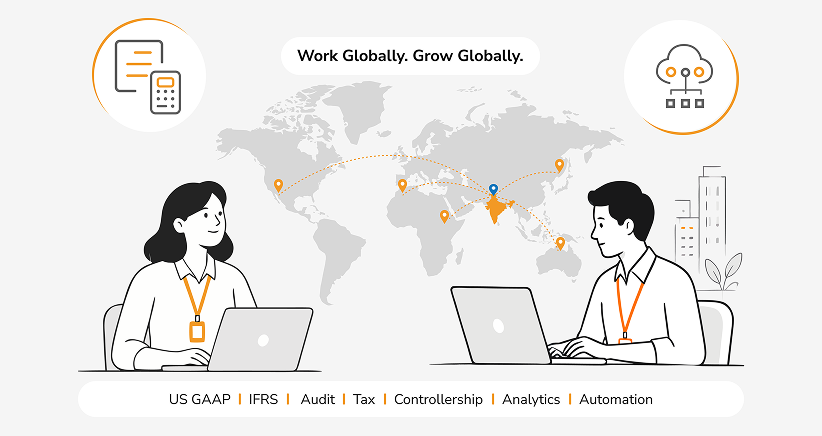
What do we offer ?
Establishing a successful GCC requires expertise across multiple domains: strategy, legal/regulatory, real estate, HR, technology, and operations. Rene Consulting’s specialized advisory ensures successful GCC establishment and ongoing operational excellence for long-term business success.
Rene Consulting’s Comprehensive GCC Advisory Services for End-to-End Setup Support
We offers a full lifecycle GCC setup solution tailored to accounting and CPA firms:
- Market research and feasibility: Assess India as a delivery location, quantify cost savings, and define the right GCC scope (audit, tax, advisory, controllership, shared services) based on firm size, client base, and risk appetite
- Entity structuring and regulatory compliance: Design optimal entity and tax structures, obtain regulatory approvals, and align the GCC operating model with US GAAP, PCAOB, SOX, SEC, and data privacy requirements from day one
- Location and infrastructure planning: Advise on city and micro‐market selection (e.g., Bengaluru, Hyderabad, Gurugram, tier‐2 hubs) based on talent depth, cost, incentives, and risk diversification; support facility, IT, security, and business continuity
- Talent and HR setup: Build the talent strategy around Indian CAs, CPA‐track professionals, and finance graduates, design org structures and role matrices, and create HR policies aligned with global standards of ethics, performance management, and employee well‐being.
Conclusion
Accounting GCCs combine global exposure, structured career development, better work-life balance, competitive compensation, and stronger organizational integration in ways that traditional outsourcing environments can struggle to match.
For firms, however, building a successful GCC requires much more than setting up an entity and recruiting a team. Market feasibility, regulatory compliance, location strategy, infrastructure, talent planning, HR, technology, and ongoing operations all need to work together.
With the right advisory and implementation foundation, an Accounting GCC can become more than a delivery center. It can become a long-term capability engine for the firm while creating stronger career opportunities for the professionals who work within it.
For accounting and CPA firms considering India as their next growth and capability destination, the GCC model offers an opportunity to build global capabilities with greater ownership, control, and scalability.
Frequently Asked Questions
1. How is working in an Accounting GCC different from working for an outsourcing provider?
In an Accounting GCC, professionals are part of the parent organization’s own team rather than an external vendor. This gives them greater ownership of processes, closer interaction with global teams, and a clearer understanding of how their work contributes to the firm’s business objectives.
2. What kind of accounting functions can professionals work on in a GCC?
Accounting GCCs can support a broad range of functions, including audit, tax, controllership, bookkeeping, financial reporting, advisory, and shared services. As GCCs mature, professionals may also work on analytics, automation, digital audit, and other technology-led finance initiatives.
3. Why is India becoming an attractive destination for Accounting GCCs?
India offers a large pool of qualified accounting professionals, including CAs, finance graduates, and CPA-track talent. Combined with growing technology capabilities and established global delivery experience, this makes India a strong location for firms looking to build scalable accounting capabilities.
4. Does establishing a GCC only involve hiring an accounting team?
No. Hiring is only one part of the process. A successful GCC requires decisions around market feasibility, entity structure, regulatory compliance, location, infrastructure, technology, talent strategy, HR, and ongoing operations. Getting these foundations right helps the GCC scale effectively.
5. How can firms ensure their GCC is aligned with global accounting and regulatory requirements?
The operating model should account for requirements relevant to the firm’s work, including US GAAP, PCAOB, SOX, SEC, and data privacy considerations. These requirements should be incorporated into the GCC’s structure, processes, technology, and controls from the beginning rather than addressed after setup.
6. What should firms consider when choosing a location for an Accounting GCC in India?
Location decisions should go beyond rental costs. Firms need to evaluate talent availability, cost, infrastructure, local incentives, scalability, security, and business continuity. Depending on the firm’s requirements, this could include established hubs such as Bengaluru, Hyderabad, and Gurugram as well as emerging Tier-2 locations.
7. How can an Accounting GCC support long-term talent retention?
GCCs can improve retention by offering clear career paths, global exposure, professional development, competitive compensation, leadership opportunities, and a stronger sense of belonging. When professionals see a long-term career within the global organization, they are less likely to view the role as simply another delivery position.
Tags